Showing posts with label least tern. Show all posts

Monday, August 26, 2013

Roseate Migration


August is a strange time of year. I consider it a summer month, but migrating birds draw my mind towards Autumn. My Fish and Wildlife internship has ended, drawing my mind towards winter.

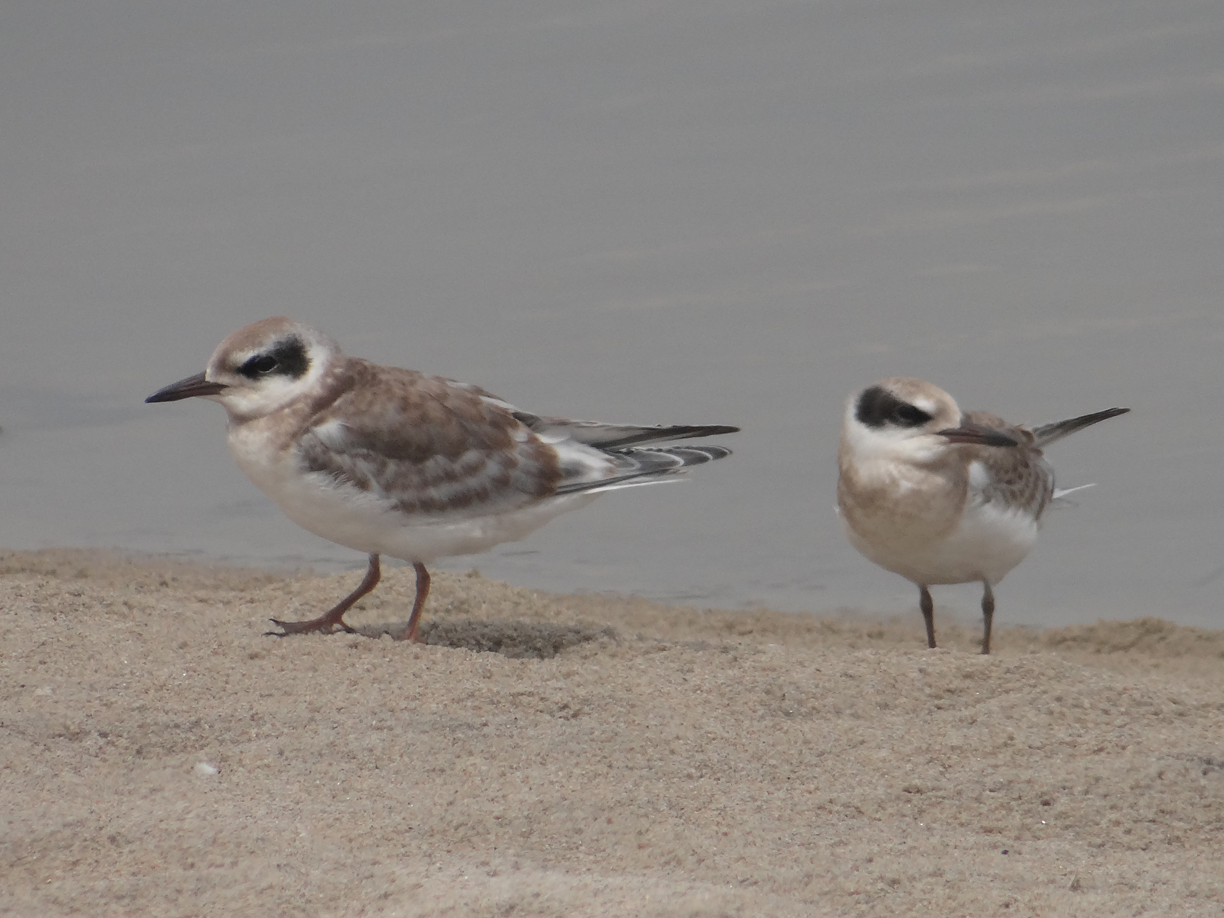
Least tern chicks.
I was very fortunate to spend the summer monitoring piping plovers, least terns, and American oystercatchers. I spent nearly every day walking on the beach and looking at birds; paradise! I especially enjoyed watching the subtle ways the beach changed – plants reestablishing on dunes, the Card’s Pond breach opening and closing, and the shift in which bird species were present or absent. The piping plover season ended early this year, which means that while there are still piping plovers running around and growing fat on insects, worms, and crustaceans, all of their chicks have fledged and are nearly indistinguishable from their parents. All of the oystercatcher chicks have also fledged, but there are still some least tern chicks hanging around, sitting on the beach and waiting for their parents to bring them fresh fish. I hope they grow quickly and well, for much like piping plovers, least terns are migratory birds. Autumn is coming and they have a long journey ahead of them: piping plovers to the south Atlantic and Gulf coasts, least terns to Central and South America.

Roseate tern.
Nor are they the only migrating birds; in the past month I have seen numerous sanderling, ruddy turnstones, common terns, and roseate terns, to name but a few of the species passing through. I am especially heartened to see the roseate terns because they are an endangered species and this is the first time I’ve seen them. They’re gorgeous birds, with long, elegant wings and a deeply forked tail. They have a pale gray upper body, a white underside, and during the breeding season they have a black bill and matching black cap. They also have a faint rosy wash on their breast feathers, but it’s very subtle and all of the birds I’ve seen have already begun transitioning to their nonbreeding plumage.

Although it is part of their historic range, roseate terns don’t breed in Rhode Island. They breed on select coastal islands extending from New York to Canada and currently their biggest colonies are at Great Gull Island in New York and Bird and Ram Island in Massachusetts. Most of the time roseate terns nest near common tern colonies. Although both species nest directly on the ground, common terns prefer to nest in open areas while roseate terns generally prefer to nest under rocks and vegetation. Their ground nesting strategy leaves both species vulnerable to predators, especially great horned owls, mink, and raccoons. To protect their nests, eggs, and chicks, adult birds will dive bomb any predator that approaches, pooping on them for good measure. 

Banded roseate tern.
Due to their endangered status, roseate tern colonies are intensively monitored and protected. Many of the young birds are captured and banded before being released. Currently, each bird is given two bands: a service band on one leg and a field readable band on the other leg. The service band is metal and contains a number unique to that individual bird, but in very small numbers. It can only be read if the bird is recaptured. Field readable bands have larger numbers and are easier to read; they can be either metal or plastic. Plastic field readable bands come in different colors and are numbered. They are designed to be read from a distance with the aid of a scope, or bird telescope, so that the birds can be identified without recapturing them. Banding birds allows scientists to study survival rates, migration, and reproductive success among other things.

Migration is a long and risky process. Roseate terns fly all the way to Brazil, where they spend the winter. Since Brazil is so far away, roseate terns don’t fly the entire way at once. Instead they stop along the way at various locations known as staging areas. Staging areas give migrating birds a place to rest and forage, gathering their energy while they wait for favorable winds to continue their migration. Although all of the juvenile roseate terns at staging areas have learned how to fly, they are still learning how to hunt and are dependent on their parents for food. Parents that return with fish are duly greeted by their loud, hungry young, bills wide open.

I spent the last couple weeks of my internship monitoring mixed species flocks of staging terns at three different beaches in Rhode Island: Trustom Pond, Napatree Point, and Sandy Point. Access is limited to prime staging habitat in all three areas to limit disturbance to the birds. This is necessary because every time they are disturbed, roseate terns (and other migratory birds as well) waste valuable energy flying away instead of resting or eating. If they are disturbed too often, they may abandon their young.

Me (left) and Brandi-Lyn Colacone (right) using spotting
scopes at Trustom Pond. Photo courtesy of Tori Lima.
The flock size at each beach varied day to day, from zero to over six hundred terns. To avoid flushing the birds, I would set up my scope at a nonthreatening distance and creep closer, sometimes no more than a few steps at a time. Either with a partner or on my own, I first estimated the flock size, then conducted an exact count of the flock size, before settling down to go through the birds one by one to determine their species (common tern, roseate tern, black tern, etc) and age (juvenile, adult). Given enough time, I would also search for banded birds. 

Certain species are distinct and easy to identify (black tern, Forster’s tern, sandwich tern), but the majority of the flock was always composed of common terns and roseate terns, who look very similar once they’re in nonbreeding plumage. The juveniles aren’t too hard to tell apart – roseate terns have darker foreheads, black bills with no hint of orange, black legs instead of pink, heavier scalloping on their back feathers, and no carpal bar on their wings – but the adults are a different story. The key differences between adult common terns and roseate terns are how much black they have on their bill, how dark their plumage is (kind of light grey
Juvenile Forster's terns.
versus very light grey), and how dark the tips of their wing feathers are. To increase the difficulty, many of the birds I saw were sitting down (can’t see their legs), preening (can’t see their bills), facing the wrong way (can’t see their bills), or hiding behind another bird (can’t see anything). Sometimes the entire flock would flush and fly away due to a pedestrian walking by, a helicopter, or no discernable reason - perhaps they all spontaneously decided they wanted to sit three inches to the left of where they were sitting before. I learned to balance speed, accuracy, and patience. I also learned to appreciate subtle differences between the birds and focus on markings I would never notice under different circumstances. I got to watch small, intimate moments like a roseate tern preening its breast feathers or a common tern feeding its overgrown chick. I got to watch a common tern return from sea with a fish, only to be chased by several other terns and a seagull, all screaming at the top of their lungs. I saw species I’ve never seen before and may never see again, including two sandwich terns that were at Trustom Pond for a single day several weeks back.
Roseate terns are still passing through Rhode Island, so I humbly ask that you help make their migration a success. Respect any fencing and closed off areas. If you flush the birds or they appear agitated, then you’re too close. Back off a little way and watch them from a distance. Roseate terns perceive dogs as predators, so leave your pets at home for just a little while longer.

Thank you. 

Thursday, June 6, 2013

Fake Least Tern Colony


An adult least tern in breeding plumage.
Least terns are the smallest American tern, measuring only nine inches long. They’re awkward on land, with oversized wings and tiny legs, but graceful in the air as they soar and dive. They’re also federally endangered in the interior US and threatened in several states, including Rhode Island. 

A least tern nest.
Least terns nest on sandy beaches. They dig shallow depressions in the sand, called “scrapes,” and lay two eggs. The eggs are well camouflaged with a sandy-gray color and black splotches, but the breeding adults are downright gaudy, with jaunty black caps and white unibrows. They nest in raucous colonies, shouting their presence to the world. This approach is perhaps a little foolhardy, for least tern chicks and eggs are little more than tasty snacks for seagulls, crows, foxes, feral cats, and other predators. Least terns aren’t defenseless, however; they will dive bomb and defecate on any predator that dares approach.

Due to their threatened status, least terns are monitored by the Fish and Wildlife Service – who I’m working for this summer as an intern. As part of an ongoing effort to protect least terns, this year we installed an electric fence in one of the overwash areas at Quonnie Beach. A shock is only provided if two wires are touched simultaneously, so predators like foxes, skunks, and raccoons get a small shock if they try to cross, but piping plovers and other small shorebirds can run through the bottom of the fence without problem. The fence is solar powered.

Of course, an electric fence doesn’t do any good if the least terns nest outside of it. So in mid-May we set up a fake least tern colony.

A fake least tern.
For the fake colony, we set up two solar powered speakers that broadcast the recorded calls of a real least tern colony. This attracted the interest of one or two least terns that flew by and called out while we worked. Next we arranged plastic terns around the speakers, carefully spacing them a meter and a half apart with an even ratio of couples and singles. Prior studies suggested that the fake colony would work, but holding the fake terns in my hands, I wondered if the real terns would be taken in. And just how badly would they be fooled? Would a clueless male attempt to woo a plastic bride with a freshly caught fish?

A crow attacking a fake least tern.
The first bird to approach the colony wasn’t a least tern at all, but a crow.  A bold bird, it flew down and approached the dummy terns before we left the fenced area. This was a source of concern since crows are known to prey on least tern chicks and eggs – a trait the crow demonstrated by attacking the dummy terns. Perhaps baffled by the terns’ stubborn refusal to fly away upon its approach, the crow approached the dummy terns from behind and pecked at their tails. No luck; the dummy terns remained in place, keeping their hypothetical eggs well hidden. The crow stepped back and examined the dummy terns from a different angle before trying again. Still no luck. Giving up, the crow flew away.

An annoyed piping plover.
The second bird to be fooled was a piping plover, a small, sand-colored shorebird that also likes to nest on sandy beaches. This particular bird had established a territory nearby and came over to give those obnoxious terns a piece of its mind. It ran about and peeped at them; “Mine! Mine! Mine!” Eliciting no stronger reaction than the crow, the plover left.

Within an hour, the stars of the hour arrived. Gee, those dummy least terns sure picked a fine location for a colony! A nice flat, sandy stretch of beach, just the ticket. Two terns flew down and started scraping. Other terns landed nearby.

This annoyed the piping plover all over again. Returning, the piping plover resumed its peeping, but the real terns were even less impressed than the fake ones. Not even the plover’s aerial display made them budge. This was their colony and they were staying.

*****

 A real least tern examining some fake least terns.
Now that three weeks have passed, I wish I had good news to share about the colony. I wish I could say that all of the terns are nesting where we want them to, well within the electric fence and away from the nearby sand road. That isn’t the case. A glitch in the MP3 player made it freeze and a strong wind blew over and scattered most of the dummy terns. We’re responsible for monitoring twelve other beaches and can’t check each beach every day, so it took several days to fix the dummy terns and even longer to find the source of the error with the MP3 player. In the mean time, the real least terns decided to pick their own colony location – and settled on nesting just outside the electric fencing. A few pairs at the edge of the colony are inside the fencing, but the majority of the colony is unprotected. It took a full day to set up the electric fencing and it would take just as long to move, creating a huge disturbance for the birds. For that reason alone, moving the fencing isn’t an option.

Fortunately none of the terns decided to nest in the sand road, but it’s still disappointing to see so much hard work come to so little. Of course this is the first year the electric fence and fake colony were attempted; there were bound to be problems. Next year will be better. And the least terns are still doing okay this year; there’s still hope. After all, there was no electric fencing last year and the least tern colony at Quonnie Beach still fledged 111 chicks.